
Barber Careers in Dallas and Houston: The History of the Fade
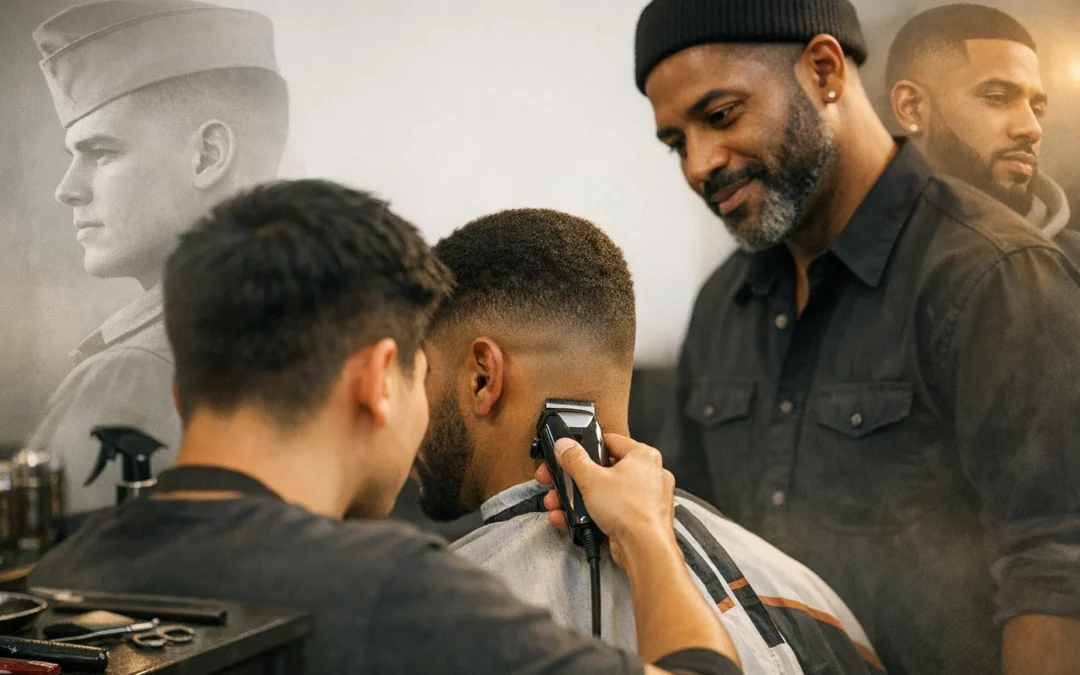
A perfect fade almost looks unreal. The sides melt from skin to shadow to texture with no visible step. The line at the temple is so clean it catches the light. Clippers hum and neck dusters flick away loose hair. For a moment, the mirror shows a cut that feels engineered, not guessed at. Most people assume this look started in a sleek studio or a music video set. Instead, its earliest shape took form in the plain barbershops attached to military bases. Decades later, it became one of the defining skills behind barber careers in Dallas and Houston today.
Military Roots of the Modern Fade
A fade haircut is a short style where hair gradually shifts from very short or skin at the neckline up to longer length on top. The transition stays smooth, with no harsh line between lengths. It grew out of strict mid-20th-century U.S. military grooming rules and eventually became a global symbol of precision and style.
During the 1940s and 1950s, regulation cuts in the U.S. armed forces demanded control and uniformity. Hair had to stay short, neat, and tapered. That kept it within code even as it grew. Meanwhile, base barbers became experts at blending hair from almost nothing at the nape to a stronger shape on top. They used simple tools, yet they still produced the same result on every recruit, week after week.
As World War II veterans returned home, that sharp taper left the barracks and stepped into civilian life. As a result, the discipline behind that cut quietly became a technical foundation. Barbers would keep building on it for decades, long before Dallas or Houston had a modern barbershop scene of their own.
The Tool That Made the Blend Possible
None of this would have spread the way it did without a change in equipment. In 1919, an Illinois engineer named Leo Wahl patented the first practical electric hair clipper. He built the motor directly into the handpiece instead of connecting it by a cord to a separate machine. Within a year, his factory had sold thousands of them to barbers across the country.
Before that invention, barbers relied on manual, hand-crank clippers. Those tools made fine blending slow and inconsistent. Electric clippers, however, changed the math entirely. A barber could now move through guard sizes quickly and smoothly. That speed, in turn, let them create a seamless gradient from skin to full length in a fraction of the time.
By the 1940s, electric clippers were standard equipment in most professional shops. Consequently, barbers could teach the technique to apprentices and repeat it consistently across clients, which is part of why the fade spread so quickly once the tool existed.
The tool did not invent the fade. Without it, though, barbers could not have delivered the fade’s precision at scale.
African American Barbershops Turn the Fade Into Art
In many African American neighborhoods, the barbershop became more than a place to get a haircut. It functioned as a social club, a news station, and a studio. Within those shops, barbers pushed the military taper further. They worked the blend tighter and sharpened the outline around the hairline.
A New Meaning Behind the Chair
Barbers turned the taper into a canvas. They experimented with higher blends, tighter edges, and crisp sideburns that framed the face. Meanwhile, conversations in the chair covered politics, music, and local life. The cut itself, in turn, marked belonging to that community. A clean fade could say that you cared about how you showed up. Similarly, keeping one signaled a kind of quiet pride that had nothing to do with the military rules it descended from.
The Fade Becomes a Signature
Over time, specific details became signatures. Some shops favored ultra-sharp front lines. Others, meanwhile, specialized in gradual, almost invisible blends. Experienced barbers passed the fade down to their apprentices through long hours on the shop floor. As a result, it became a craft and a quiet badge of identity in an era when style and self-respect were deeply linked.
Hip-Hop Pushes the Fade Into the Mainstream
By the 1980s, hip-hop was moving from local parties to national stages, and barbers moved with it. The high-top fade, flat on top and tapered tight on the sides, became one of the most recognizable haircuts of the decade. Will Smith wore the style on The Fresh Prince of Bel-Air, and television, as a result, brought it into millions of homes each week. Barbershops, however, had already perfected the cut for years before it reached that wider audience.
Music videos and album covers, meanwhile, carried these looks far beyond the neighborhoods where they started. Young fans studied those cuts and walked into their own barbershops asking for the same shapes. Barbers who could deliver those exact looks, consequently, built reputations that lasted for years.
As demand grew, barbers had to raise their technical game. Blending high against a flat top and keeping lines razor sharp took serious repetition. Repeating that result on client after client took even more. The cut that began as a military standard, therefore, became a moving target, constantly evolving with new artists and new expectations.
The Fade Goes Global
By the 1990s and 2000s, the fade had moved well beyond American barbershops. Professional athletes and actors wore tapers and fades on camera regularly. Film, meanwhile, gave the barbershop itself cultural weight too. Movies began portraying it as a hub of community life, not just a place for a haircut.
International audiences picked up the style as well. Soccer culture in Europe, for example, helped normalize tight fades and undercuts on a global stage. Distinct regional takes on the fade also developed within Latin American and other communities, and each one added its own signature details. According to the U.S. Bureau of Labor Statistics, demand for barbers, hairstylists, and cosmetologists continues to grow faster than average nationwide. That growth, in turn, tracks with the style’s spread well beyond its original American roots.
A military regulation eventually became a haircut requested in barbershops on nearly every continent. Each community that adopted it, however, shaped its own version.
What It Takes to Cut a Great Fade Today
Ask ten barbers what makes a fade great and you will get ten slightly different answers. They all point at the same idea. A smooth, seamless gradient with no visible steps. Sharp lines in exactly the right place. A result that still looks clean weeks later as it grows out.
The Modern Toolkit
Modern barbers use a full toolkit to hit that mark. They reach for corded and cordless clippers, detail trimmers, and straight razors. Most move through several guard sizes first, then go back in with clipper-over-comb work to smooth out any remaining shadow lines. High fades, low fades, taper fades, drop fades, and bald fades each describe a different blend height and transition point. Each one, however, also behaves differently depending on hair texture and head shape. What works cleanly on one client can look completely different on the next.
Why the Consultation Matters Just as Much
The best fades, in fact, start before the clippers ever touch the head. A skilled barber asks how a client styles their hair day to day. They also ask what the client’s schedule allows for touch-ups and what look they are actually trying to achieve. Then, based on those answers, they build the cut instead of applying the same template to everyone.
Barber Careers in Dallas and Houston Today
That kind of precision, ultimately, shapes strong barber careers in Dallas and Houston. Shops here still treat a clean fade as proof of real skill. Barbers who can deliver high, low, taper, drop, and bald fades consistently, as a result, tend to keep their chairs full.
Career Schools of Texas builds its Barber program around both classic skills and modern techniques for cuts like these. You can find more on the school’s policies and community on the school information page. If learning the craft behind the fade has you curious, call (833) 833-2788 to talk about where that curiosity might lead next.