
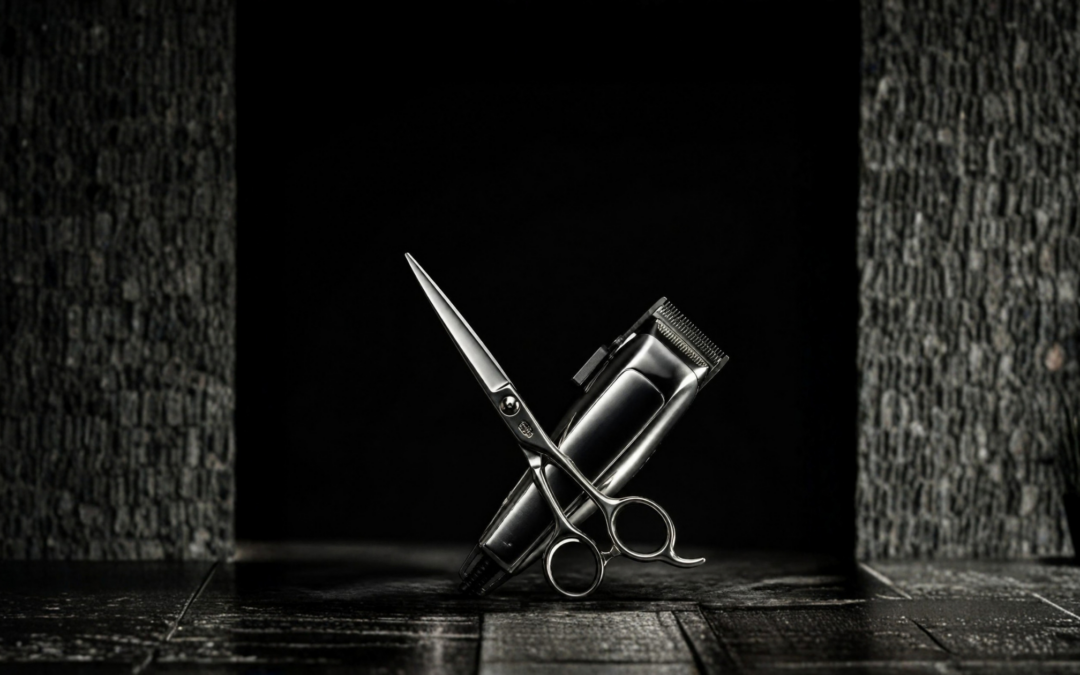
The Great Debate: Scissors vs. Clippers, What’s Actually Better?
Everyone has an opinion on the classic scissors vs clippers haircut debate. Some swear clippers are the only way to get a clean fade, while others insist real artistry lives in the scissors. The truth is more interesting than picking a winner, and it goes all the way back to manual clippers in the 1800s.
Manual clippers appeared in barbershops decades before electric models, letting barbers cut hair quickly by squeezing spring-loaded handles. Electric clippers followed in the early 1900s and changed the pace of cutting forever, as documented in Wikipedia’s history of the hair clipper.
Scissors vs Clippers Haircut: What Clippers Really Do Best
In the scissors vs clippers haircut debate, clippers shine when you need fast, repeatable length on large areas of hair. Their motorized blades and guard system let barbers set precise lengths, build fades in controlled steps, and keep both sides of the head perfectly even on tight schedules.
Because guards control length, clippers are perfect when a client wants a specific number. A 1 guard leaves hair at a very short stubble, while a 4 guard leaves a short, soft covering that still shows scalp shape. With those fixed lengths, a barber can move smoothly around the head and know every pass is consistent.
For fades and skin fades, clippers are essential. First, the barber sets the shortest point, often right at skin level. Then the guard sizes are stepped up gradually, creating a smooth transition from bare skin to longer hair. Without clippers, that clean, sharp fade you see everywhere in Texas barbershops would take much longer and be harder to repeat.
Clippers also remove bulk quickly. For example, when a client with very thick hair wants a tight taper around the ears and neckline, clippers clear the lower section in a few passes. After that, the barber can come back with more detailed tools to refine the shape.
What Scissors Actually Do Best in Modern Haircuts
If clippers are about speed and uniform length, scissors are about shape and movement. In a modern haircut, scissors let the barber choose exactly where weight sits, how the hair lies, and how it feels as it grows out.
Scissors excel at directional cutting. By changing the angle of the blades, a barber can keep weight over a cowlick, open up a heavy fringe, or build a soft, layered top that falls into place without styling products. Techniques like point cutting, slide cutting, and scissor-over-comb all rely on this precise control.
Texture is another scissor specialty. Instead of leaving every strand exactly the same length, a barber can create micro-variations that break up hard lines. For instance, a textured crop on top often comes from scissors cutting into the ends so the hair stands and separates slightly, rather than lying perfectly flat.
Scissors are also ideal for layered and longer styles. When hair reaches several inches in length, running clippers through it can leave blunt shelves and flat, boxy shapes. With scissors, a barber can build long layers that move when you turn your head, and can remove bulk without chopping away desired length.
For a deeper technical comparison of how each tool works, many professionals study guides like this breakdown of clipper and scissor technique and then practice those ideas on the shop floor.
Why Curly and Coily Hair Changes the Tool Choice
Curly and coily hair brings a different layer to the scissors vs clippers haircut conversation. Because tight curls spring up and shrink when dry, small differences in length can become very visible as the hair grows out.
When clippers are used heavily on very curly or coily textures, clipper lines can sometimes show as the hair gets longer. The curls expand away from the head, and those precise, uniform clipper sections may create visible steps instead of a smooth shape. For some clients, especially with very tight curl patterns, that look feels too sharp.
Scissors handle this challenge differently. By cutting curls in smaller sections and following the way each curl group naturally forms, a barber can build a shape that grows out more softly. Instead of one exact guard length on an entire area, the cut follows the curl pattern and head shape.
That is why some barbers and clients prefer scissors-only cuts for certain curly or coily styles. A rounded shape on top, for example, can be sculpted curl by curl with scissors so it keeps its form even as it grows. Clippers may still appear around the neckline or edges, but scissors do most of the shaping.
Here is the key point: this preference is technical, not a stereotype. Different textures respond differently to tools. The best barbers learn how to read curl pattern, density, and shrinkage, then choose scissors, clippers, or both to protect the shape as it grows.
Scissors vs Clippers Haircut: The Real Answer Is Both
So, what is actually better, scissors or clippers? For real-world haircuts, especially in busy shops around South Dallas, East Dallas, and Houston, the answer is almost always both. The real skill is knowing when to reach for each tool and how to combine them for the result you want.
Many cuts start with clippers on the sides and back to set the base length and fade. Then scissors shape the top, connect the fade to the longer hair, and refine the fringe, crown, and any stubborn areas. Even finishing touches, like softening a hard line near the temple, often come from a few quick snips.
If you enjoy this kind of technical debate, you might also enjoy learning how to do the work yourself. At Career Schools of Texas, the Barber program trains you on both tools from day one, so you understand not just how to hold them, but why you are choosing each one.
With campuses in South Dallas, East Dallas, and the Houston campus, you can train close to home while building real shop-floor skills. Instructors focus on practical technique, safety, and state licensing preparation, so you can step confidently into a Texas barbershop.
Learn about the Barber program | Talk with admissions | Apply now
Phone: (833) 833-2788