
What’s a Skin Fade, Taper, or Burst Fade? A Style Guide for Everyone
If you have ever sat in a Dallas or Houston barbershop and just asked for “a fade,” you are not alone. There are many types of fade haircuts, and each name tells your barber something different about the cut you want. Without a clear pattern, the names can feel like a secret code.
This guide breaks that code into simple terms. You will learn the three-question pattern behind fade names, see examples of how to order a cut, and understand why fades take real practice. Nothing here promises a perfect result, because every head and hair type differs. By the end, you can walk into your next appointment feeling ready instead of unsure.
Types of Fade Haircuts: The Three-Question Framework
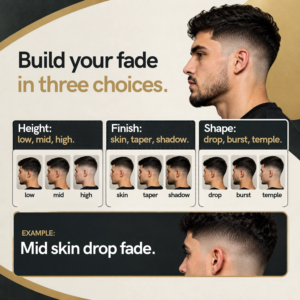
In most barbershops, fade names follow one pattern built from three questions. First, where does the blend start on the side of your head: low, mid, or high? Second, how short does it get at the bottom: skin, taper, or shadow? Third, what shape does the blend follow around your ear and neckline: drop, burst, or temple? Answer all three, and you give your barber a clear map.
For example, a “mid skin drop fade” names a mid-height blend, a skin finish, and a drop shape that dips lower in the back. Another person might ask for a “low shadow burst fade” to start the blend low, stop at a short guard, and arc around the ear. You do not have to memorize every name you hear in the shop. Focus on height, finish, and shape as separate choices, and you are already speaking the language. Barbers sometimes use the words a little differently, so ask for a photo or an explanation if a name confuses you.
Types of Fade Haircuts by Height and Finish
Height tells your barber where the shortest area begins. A low fade starts just above the ear and low on the neckline, so it keeps more side weight and feels subtle. A mid fade starts around the temple and offers balanced contrast. A high fade begins above the temple and creates the most contrast between the sides and the top.
Finish explains how short the fade gets at the very bottom. A skin fade, also called a bald fade, blends right down to bare skin and can be low, mid, or high. A taper stays mostly at the sideburns and neckline and does not reach skin, so the change is gentler. A shadow fade stops at a short guard instead of bare skin, which softens the look further.
These choices also change how the cut grows out. Skin and high fades create strong contrast, so regrowth shows sooner. Low fades, tapers, and shadow fades tend to grow out more softly. For timing advice, see this guide on how often to get a fade.
Shape Around the Ear: Drop, Burst, and Temple
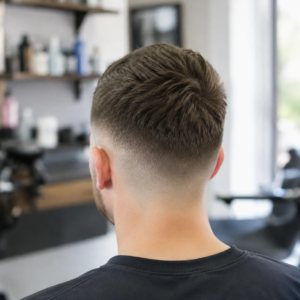
Once you know the height and finish, the last piece is shape. A drop fade curves down behind the ear and sits lower in the back, following the natural curve of the head. A burst fade arcs in a half circle around the ear and leaves the back longer. A temple fade stays near the temples and sideburns. Any of these shapes can be cut low, mid, or high.
One clear request might sound like this: “I would like a low shadow burst fade with some length left at the neckline.” That tells your barber where to start the blend, how short to go, and how to carry it around the ear. If speaking up feels awkward, bring a photo and explain how you wear your hair for work. The how to talk to your barber guide covers photos, guard numbers, and speaking up during the cut.
Why Fades Take Practice
Once you know the pattern, it is easier to see why a clean fade takes real practice. A smooth blend depends on a steady clipper angle, even pressure, and careful transitions between lengths. Hair type and growth patterns change how those choices show up, so the same fade can look different on two people. The science of a fade guide explains how texture, density, and growth patterns affect the result.
Haircutting, fades, shaving, and client consultation are part of the Barber program at Career Schools of Texas. In Texas, a barber license requires 1,000 hours of approved training and two exams, one written and one practical, through the Texas Department of Licensing and Regulation. There is no application deadline, and the admissions team can explain schedules and financial aid options. Nothing here promises clients, income, or a job.
Ready to Talk Fades With Confidence?
If you live near the Dallas campus on S. Lancaster Road or the Houston campus on Gessner Road, you already have a local place to keep learning. Now that you know how height, finish, and shape work together, you can describe your fade clearly and ask better questions in the chair. The school information page can help you plan a visit.
Learn about the Barber program | Schedule a campus visit | Apply now

Texas Blog Footers
Dallas campus: 5148 S. Lancaster Road, Dallas, TX 75241 | (833) 833-2788
Houston campus: {insert Houston address on Gessner Road} | (833) 833-2788
This post may include AI-generated images, which illustrate ideas and do not depict actual Career Schools of Texas students, staff, or facilities.