
The Shape-Up: Why This Quick Service Is Serious Craft, Not a Shortcut
A shape up sounds like a quick extra at the end of a haircut. Because it looks fast, it is easy to treat a shape up haircut like a simple add-on instead of a serious service. In reality, that sharp outline around your hairline takes planning, focus, and a steady hand every time.
This guide walks through what a shape up is, how barbers in Dallas and Houston cut it, and how to ask for the results you want. You will learn about the four edges, common neckline choices, and realistic upkeep. Nothing here promises clients, income, or any specific results, but it can help you understand the craft behind that crisp line.
What a Shape Up Haircut Is and How It Started
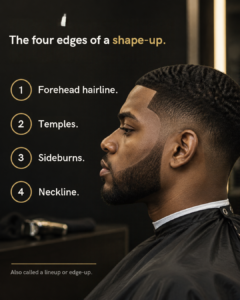
A shape up haircut sharpens the outline of your hairline without changing the rest of your haircut. Your barber focuses on four edges: the front hairline across your forehead, the corners at your temples, your sideburns, and the line at the back of your neck. They usually reach for a trimmer first and sometimes finish with a straight razor to clean up tiny hairs. Some shops call the same service a lineup or an edge-up, and the preferred term can shift from place to place. When you ask for a shape up, many barbers work around the full perimeter unless you say otherwise.
The style has deep roots in barbershop culture. According to Wikipedia, the shape-up became popular in the mid to late 1980s, especially among people with Afro-textured hair, and hip-hop and pop culture helped spread it. It also influenced styles like fades, parts, and waves. For the wider story, see this history of the fade, and for blends that often pair with a clean lineup, see these types of fade haircuts.
How a Barber Cuts a Shape Up Haircut
Even if the service is quick, your barber usually starts with a short talk about your line. They may touch along your hairline with a comb or finger to mark the edge. Then they often set a starting point in the center of your forehead, hold the trimmer level, and work outward in small, straight strokes. Some barbers finish by gliding a straight razor along the line for extra crispness.
The temple corners are usually the most demanding part. Those tiny right angles must be sharp and matched on both sides, and a small move in the wrong direction can cut into your natural line. That is why a good barber follows your existing hairline instead of chasing a perfectly new shape. Each time a line is cut slightly behind your true edge, the fine hairs in front of it are removed, and over months the hairline can creep back.
Your neckline is another key decision. A blocked neckline is a clear horizontal line across the back, a rounded neckline follows an arc, and a tapered neckline gradually fades to skin without a hard edge. Whichever you choose, your barber has to connect that back edge smoothly to your sides and match the outline you wear in front.
How to Ask for a Shape Up Haircut and Keep It Fresh
When you sit down, the words you use matter. Say “shape up,” “lineup,” or “edge-up” instead of a general “clean up,” which can mean a lighter trim. Name the areas you care about, such as “front and temples only” or “front, temples, and neckline.” Say whether you want the front line square, slightly rounded, or closer to your natural curve. Bring a clear front photo and a three-quarter photo, and ask your barber to follow your natural hairline rather than push it back.
Shape ups do not last forever, and that is normal. One barber academy says hairlines can soften within roughly 10 to 14 days, with necklines sooner. If you have razor bumps or sensitive skin, you can ask for trimmer-only work so your barber skips the razor. Some barbers say a detail trimmer can handle very light regrowth between visits, but one small slip will show quickly, so be cautious.
Why This Quick Service Takes Serious Skill
It is easy to look at a finished shape up and think it took only a few flicks of a trimmer. In reality, your barber has to hold lines level, match both temples, and respect your natural hairline, all within inches of your face. Small errors show instantly. That level of control comes from practice with haircutting, fades, shaving, and client consultation, not from guessing in the moment.
Haircutting, fades, shaving, and client consultation are part of the Barber program at Career Schools of Texas, which has a Dallas campus on S. Lancaster Road and a Houston campus on Gessner Road. In Texas, a barber license requires 1,000 hours of approved training and two exams, one written and one practical, through the Texas Department of Licensing and Regulation. There is no application deadline, so you can explore timing that fits your life. The admissions team can explain schedules and financial aid options. Nothing here promises clients, income, or a job.
Ready to Learn More or Plan a Visit?
If you care about how your shape ups look, you already know good barbering when you see it. If you are curious about learning those skills yourself, the school information page can help you plan a visit.
Learn about the Barber program | Schedule a campus visit | Apply now

Texas Blog Footers
Dallas campus: 5148 S. Lancaster Road, Dallas, TX 75241 | (833) 833-2788
Houston campus: {insert Houston address on Gessner Road} | (833) 833-2788
This post may include AI-generated images, which illustrate ideas and do not depict actual Career Schools of Texas students, staff, or facilities.