
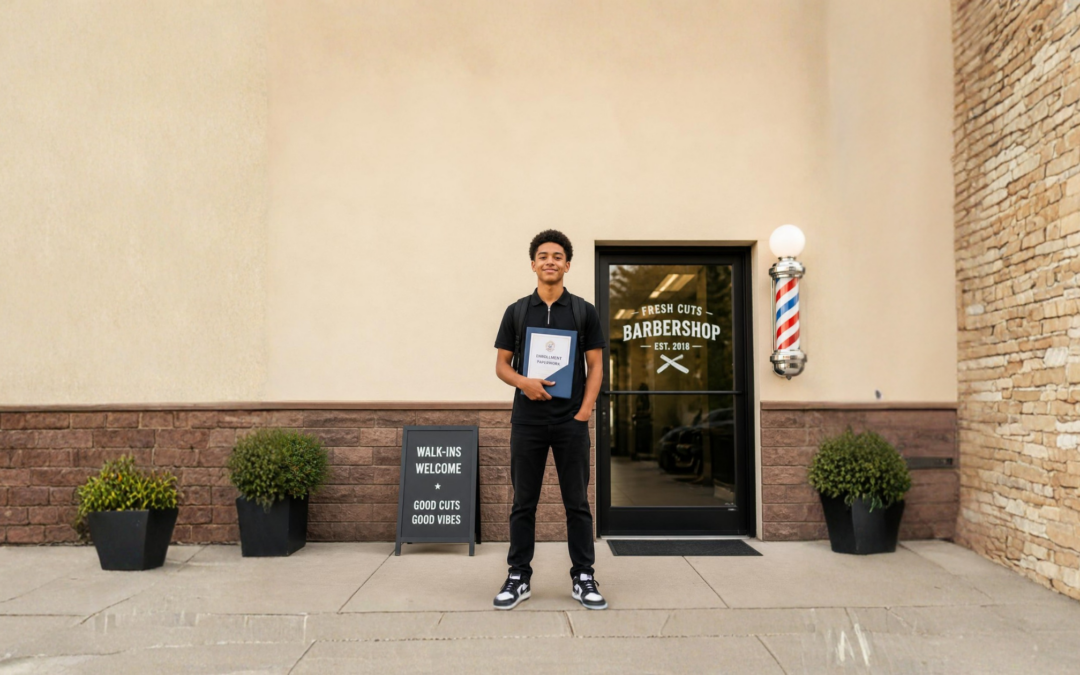
Barber School Requirements in Texas: What You Need to Enroll
Texas Barber School Requirements at a Glance
If you are ready to enroll, barber school requirements Texas come down to your age, your education background, and a short list of documents. In most cases, you must be at least 17, have a high school diploma or GED if you plan to use federal financial aid, and provide standard identification like a photo ID and Social Security documentation.
For future barbers in Dallas or Houston, it helps to separate three layers of rules. First, Texas state law sets the minimum age and licensing rules through the Texas Department of Licensing and Regulation (TDLR). Second, accreditation and federal Title IV rules apply if you want to use financial aid at Career Schools of Texas. Third, your own situation determines exactly which documents you will bring to your admissions appointment.
Career Schools of Texas has four campuses across Dallas and Houston. The Barber program is licensed by TDLR and accredited by the Council on Occupational Education. That is why you will hear both state terms and financial aid terms during your admissions conversation.
The 17-Year Age Rule and Texas Licensing Requirements
Barber school requirements Texas start with age. To receive a Class A Barber license, TDLR requires that you be at least 17 years old. This is a statewide rule that applies to every barber school in Texas, not just Career Schools of Texas.
TDLR explains that you must complete a 1,000-hour Class A Barber course at a licensed school, pass both a written exam and a practical exam, and be at least 17 when you apply for the license. You can review this directly on TDLR’s Class A Barber license page.
How the Age Rule Changed in 2023
Until 2023, the minimum age for Texas barber licensure was 16. The Legislature and TDLR raised the minimum to 17 as part of an update to barbering and cosmetology law. This change applies at the licensing level, not as a school preference.
Enrollment timing relative to your 17th birthday is exactly the kind of detail that varies by individual circumstance, so it is worth confirming directly with the admissions team rather than assuming a general rule applies to your specific situation.
State Rules vs. School Decisions
TDLR’s rules set the floor. Schools may still choose to set their own admissions standards that are equal to or higher than the state minimum. When you hear that you must be 17 to get licensed, that is Texas law. When you hear about interviews, references, or school forms, those items come from Career Schools of Texas policies, not from TDLR.
Education Rules: TDLR vs. Financial Aid and Accreditation
Education is where barber school requirements Texas can be confusing. TDLR does not require a high school diploma or GED for the Class A Barber license itself. Instead, TDLR focuses on your training hours, exams, and age.
However, Career Schools of Texas is accredited by the Council on Occupational Education. As an accredited school that participates in federal Title IV financial aid programs, it must follow additional rules for students who use federal aid. Federal student aid rules, explained at studentaid.gov, generally require that a student have a high school diploma, GED, or equivalent to receive federal grants and loans.
What This Means If You Want to Use Financial Aid
In practice, most enrolling students at Career Schools of Texas plan to use federal financial aid. For those students, a high school diploma, GED, or equivalent is required because of Title IV and accreditation standards, not because Texas barber law demands it.
If you do not have a diploma or GED, you can still discuss your options with the school. You may have non-federal payment options or future plans to complete your education. Those conversations are personal and handled case by case with the financial aid and admissions teams.
Documents, Training Hours, and Exams on Your Path to Licensure
Beyond age and education, barber school requirements Texas usually involve a short list of documents and a clear training path. Commonly requested documents include a valid government-issued photo ID, such as a driver’s license or state ID, and your Social Security card or official documentation of your Social Security number. Schools also often ask for your high school diploma, GED certificate, or homeschool documentation if you plan to use federal aid.
Typical Enrollment Checklist
As you get ready to enroll at Career Schools of Texas, you can expect to:
- Complete an initial interview with an Admissions Representative
- Provide a valid government-issued photo ID
- Provide your Social Security card or official proof of number
- Share proof of high school completion or GED for financial aid use
- Fill out an enrollment application and provide reference contact details
These items reflect common practice at Career Schools of Texas and similar institutions. Specific requirements can vary based on your background, transfer hours, or benefit programs, so the admissions team may request additional paperwork.
Training Hours and Exams After You Enroll
Once you are enrolled in the Barber program, the focus shifts from paperwork to training and licensing steps. Texas requires 1,000 hours of instruction in an approved Class A Barber course. During training, you will build skills in haircutting, shaving, safety, sanitation, and client service.
After you complete at least 900 of those hours, your school can notify TDLR that you are eligible for the written licensing exam. When you complete all 1,000 hours and pass the written exam, you can take the practical exam. TDLR outlines this two-exam process on its Class A Barber license page.
When you have passed both exams and are at least 17, you can apply for your Class A Barber license and begin professional work once licensed.
Final Steps and How to Move Forward
Requirements are often more manageable than they first appear. With one clear checklist in front of you, you can focus on preparing for training rather than guessing about rules.
Learn about the Barber program | Schedule a campus visit | Apply now
Phone: (833) 833-2788