
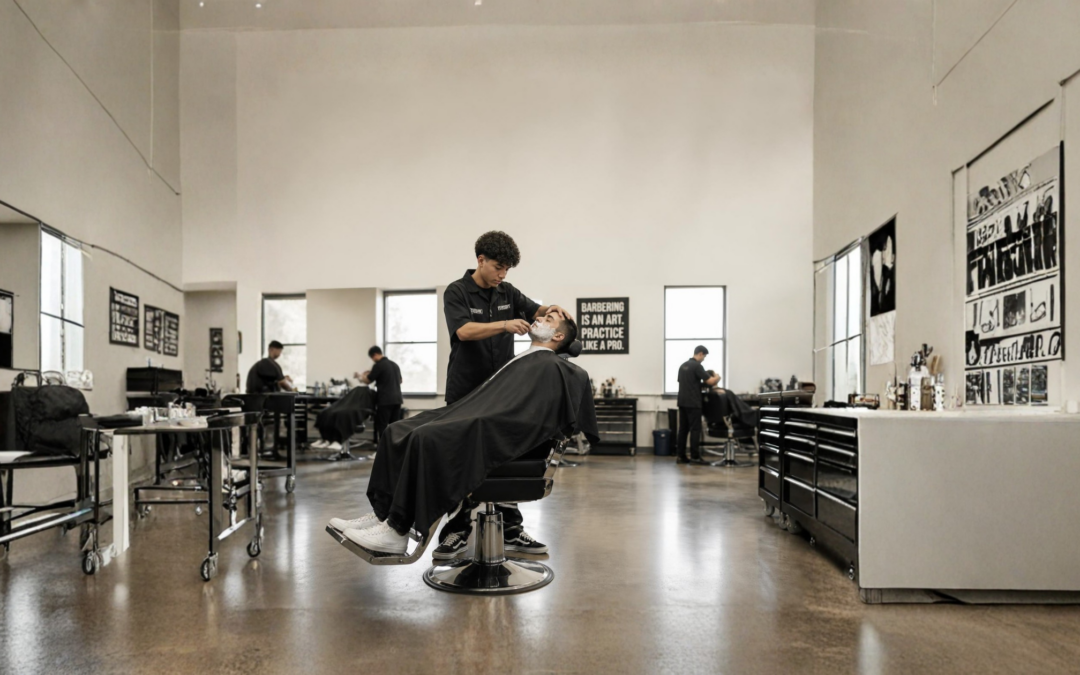
A Day in the Life of a Barber Student in Texas
Morning: Settling Into Class as a Barber Student in Texas
The day for a barber student Texas usually starts the same way: walking in from the Texas heat, signing in, and shifting from regular life into training mode. You drop your bag, check your kit, and get ready to focus on the basics that keep barbers, clients, and the shop safe.
In the morning, the pace is a little quieter. You might be in a theory classroom at Career Schools of Texas with other students, notebooks open, reviewing how sanitation and safety actually work in a real barbershop. Instead of just memorizing rules, you hear stories about why those rules matter, like how cross-contamination can happen if tools are not cleaned correctly between clients. The instructor might point out how state regulations connect to what you are learning so you start to see the bigger picture.
You study the foundation of haircutting and shaving technique, but it is not all diagrams on a board. There is steady back and forth: someone asks how to balance speed with quality, another student jokes about the first time they held clippers, and the room relaxes. Even in theory, you are already thinking like a working barber, not just a student.
Building Habits From the Start
Over time, these mornings shape your habits. You start to set up your tools in a consistent order. You wipe down your station the same way every time. You practice the language you will use with future clients, like how to ask clear questions and confirm what they want. Little by little, classroom time feels less like school and more like preparing for a real shop.
If you want to see how Career Schools of Texas structures its training overall, you can explore the Barber program or review general details on the school information page.
Midday: Hands-On Practice That Builds Barber Student Texas Skills
By midday, the energy shifts. As a barber student Texas, you usually move from sitting at a desk to standing behind a chair, working on mannequins or practice heads. This is where the techniques you discussed earlier start to feel real in your hands instead of just in your notes.
You might start with simple sections and basic cuts, repeating the same motions until your hands remember them without you thinking. At first, even holding the comb and clippers at the right angle can feel awkward. After a while, though, you notice your fades look cleaner and your lines more consistent. Classmates trade feedback and small tips that only make sense once you have tried the cut yourself.
Instructors walk the room, watching your posture, checking your clipper control, and reminding you about safety and sanitation as you work. When someone struggles, they do not just fix the cut for them. Instead, they guide their hands, explain the adjustment, and step back so the student can finish it.
Turning Repetition Into Confidence
The middle of the day can feel repetitive, but that repetition is what builds confidence. You might run the same clipper guards through the same pattern again and again until the motion feels natural. You practice draping and draping again, paying attention to comfort and coverage. You sanitize tools between mannequin sessions so the process is automatic when real clients arrive.
If you are wondering what it takes to move from this practice phase into enrollment, the admissions team at Career Schools of Texas can walk you through requirements, questions about your background, and what to expect when you start.
Afternoon: Clinic Floor Clients for a Barber Student Texas
In the afternoon, a barber student Texas often heads to the clinic floor. The mood is different from the classroom. There is more conversation, the sound of clippers is steady, and real clients are signing in for supervised services. For many students, this first season on the clinic floor is both exciting and nerve-racking.
You might start by watching an experienced student handle a full service from greeting to finish. Then it is your turn to set up your station, greet your client, and confirm what they want. Your instructor is nearby, checking your consultation, reminding you to keep calm, and stepping in only when needed.
Each client is a little different. One wants a quick clean up. Another wants to talk through a new style. You learn to adjust your approach, ask better questions, and manage your time while staying focused on safety and professionalism. The first time a client looks in the mirror, smiles, and says they will come back to see you, it hits that you are not just practicing anymore.
Learning From Real-World Moments
Not every cut goes perfectly, and that is part of the learning. Maybe a blend takes longer than planned, or a line is not as sharp as you hoped. Under supervision, you talk it through, make adjustments, and finish as strong as you can. Those small challenges build resilience and problem solving that you cannot fully learn from books.
By the end of the afternoon, you have a better feel for what working in a barbershop in Dallas or Houston might actually feel like, from the pace of clients to the flow of the room.
End of Day: Small Wins That Keep a Barber Student Texas Going
As the day winds down, a barber student Texas shifts back from client mode to student mode. Stations get wiped down carefully, tools are cleaned and stored, and the floors are cleared so the space is ready for the next day. The same sanitation habits you learned in the morning show up again here, closing the loop.
Before you leave, you might review what went well and what felt challenging. Maybe you finally nailed a fade you have been working on for weeks. Maybe you handled a nervous client with extra patience. Classmates often swap stories, laugh about small mistakes, and share tips they picked up from instructors or clients.
Looking Ahead and Taking the Next Step
Walking out to the parking lot, you can feel that each day has a rhythm. Morning theory builds your knowledge, midday practice sharpens your skills, and afternoon clients teach you how it all comes together. The structure repeats, but you are a little better each time.
Learn about the Barber program | Talk with admissions | Apply now
Phone: (833) 833-2788